
How to Search the Locust Court Docket
Locust does not publish a separate docket portal. For an eligible state matter tied to the city, open the North Carolina Judicial Branch Portal and use Smart Search. The tool takes case numbers and party names. It also accepts citation numbers, attorney identifiers, record numbers, business names, cross-references, and even nicknames. When the location filter appears, narrow your Locust-related state search to Stanly.
Know which kind of citation you hold before searching or paying. The city code draws a line between two citation types. One is an ordinance citation. The other is a State of North Carolina citation. A state citation belongs in Portal or with the Stanly Clerk. An ordinance citation belongs in the process Locust publishes. So do not assume a Portal case must appear for it.
Portal's published filter options include the optional Stanly location control, case type, case status, and file-date range. A party date-of-birth field is also there, but it is masked in the public display. Treat these as refinements for a state search. They are not a promise that every Locust-related record shows the same detail.
- Read the Locust citation to identify the issuing source and court instructions.
- For a state case, search Portal by citation, case number, or party name.
- Narrow the Locust-related state search to Stanly and available case filters.
- Open the eligible Case Summary and use Search Hearings for a date.
- Use the Clerk for a court file, official copy, or a Locust state-case question that Portal does not resolve.
Locust State Court Docket Route
Locust runs no city court portal. A state case connected with the city lives in Stanly's state-court and Clerk structure wherever Stanly has venue. Portal is how you search it. District Court takes misdemeanors and infractions, including ordinary traffic matters. Superior Court hears felonies and civil actions above the statutory threshold.
None of this makes City Hall or the police office a keeper of court records. The practical path is simpler than that. Portal covers eligible public information. Search Hearings and the calendars give a Locust state-court date. Then the Stanly Clerk handles paper files, certified copies, and any court-record question.
Locust Municipal Court Finding
Locust's city materials publish no separate municipal court. They also list no court calendar, case search, court judge, or city court caseload. This limits what can be claimed here. It does not prove that every Locust citation lands in state court. A city ordinance process can exist even without a Locust docket portal.
For a state case, use the channels the Judicial Branch describes. For an ordinance issue, work through the City process and confirm the issuing source. A city office is not a court clerk. No municipal calendar exists to describe.
Note: No official Locust source supplies a city-only docket search or a city-only court calendar.
Locust City Hall and Police Contact
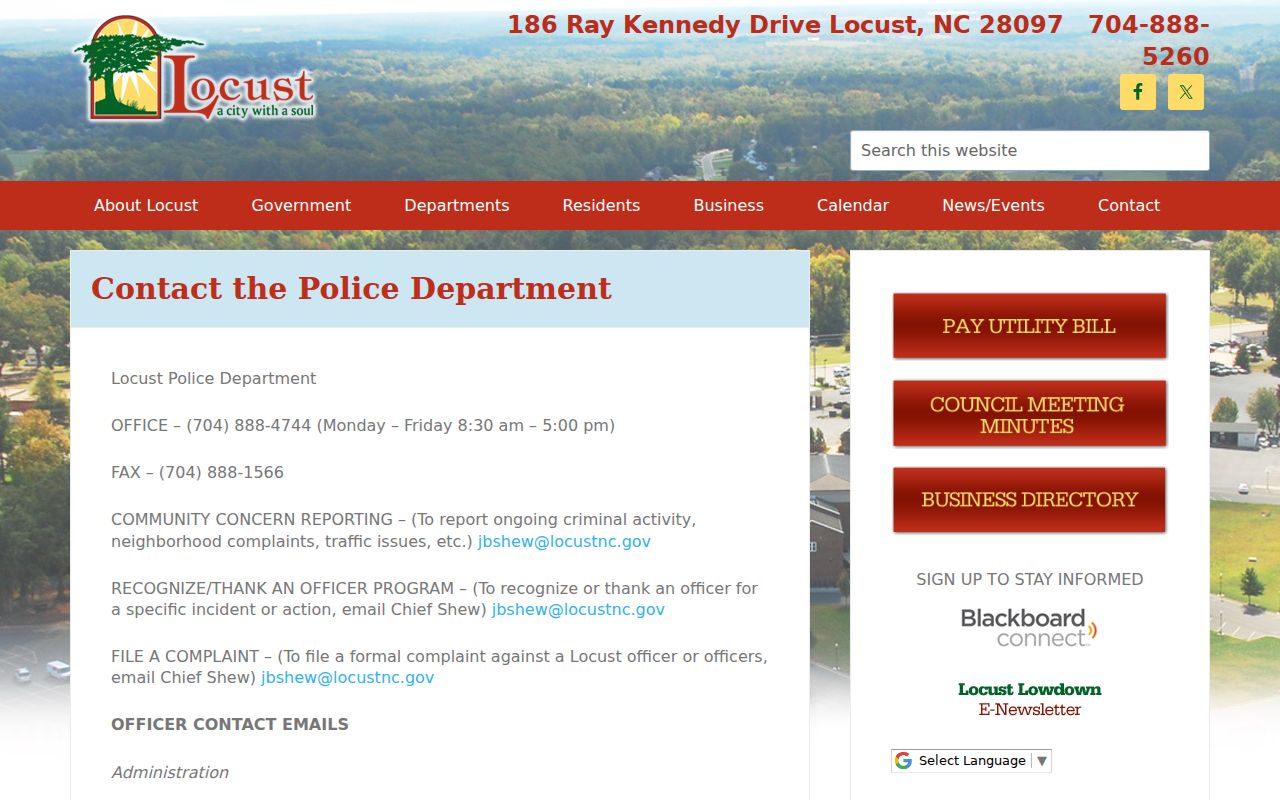
Locust City Hall and the police contact point sit at 186 Ray Kennedy Drive, Locust, NC 28097. The city's main number is (704) 888-5260. The police office is (704) 888-4744. These contacts work for identifying a municipal office or enforcement agency. They are not a state-court case lookup, calendar, clerk counter, or certified-copy channel. The Locust Police Department contact page posts it officially.
Calling that Locust contact point can help you separate a city enforcement question from the Stanly court file that may follow a state citation. City Hall answers city matters. The clerk handles the docket.
Locust City Hall
186 Ray Kennedy Drive
Locust, NC 28097
(704) 888-5260
Locust Police Office
City contact for local enforcement questions, not court-record certification.
(704) 888-4744
Locust Court Dates and Settings
For a Locust state-court date, use Portal Search Hearings and the North Carolina county calendar service. The city publishes no court calendar of its own. A county calendar groups cases set for one session. Portal Case Events gives the eligible history of a single case. Neither is a substitute for the other. A City Hall hours listing replaces neither. The Court Dates service points you to Portal and the local calendars. Settings can shift through a continuance, a closure, or later court action. So trust the current Locust state-court date until Portal, the court, or the Stanly Clerk confirms a new one.
| Case or citation | Published Portal search keys for a Locust-related state matter. |
|---|---|
| Location | Use Stanly where the Portal control is available. |
| Hearing type | Published categories include Criminal, Civil, Family, Probate, and Mental Health. |
| Case Events | Portal's date-ordered activity list where public information is available. |
| Confirmation | Call the Stanly Clerk when a Locust court date is urgent or unclear. |
Locust Hours and Court Dates
Locust City Hall keeps hours of Monday through Friday, 8:30 a.m. to 5:00 p.m. Those are business hours, not court hours. They set no Locust court session or state appearance date. Availability of a court file is not guaranteed either. The municipal office and the state court do different jobs. The same person, citation, or event can connect to Locust anyway.
For the current state date, rely on Portal, the county calendar, and the Clerk. City hours matter only for ordinance or city-service contact. Keep that distinction straight. It keeps a city office schedule from being mistaken for a Locust court docket setting.
Locust Traffic Tickets
Where a Locust ticket goes depends on who wrote it. A citation from the State of North Carolina belongs in the state court process. Hold onto it. Search Portal with its number, or by party and case where that is allowed. Call the Stanly Clerk if a date looks unclear. Ordinary state traffic matters land in District Court. Do not treat one as a Locust city docket item.
Some minor speeding or equipment citations qualify as waivable under the state's traffic guidance. Anything else stays on a court calendar. Wanting to fight it keeps it set for court too. The local ordinance appeal route cannot substitute for the state process. The citation itself and whoever issued it control the next step.
For a waivable state citation, the statewide instructions lay out online, in-person, and mail options. The mail route asks for a signed, dated waiver. Send it with the citation and an approved payment method. Cash and personal checks are not accepted. That guidance creates no Locust city payment portal either. A non-waivable citation still requires keeping the court date.
Locust Ordinance and State Citations
Locust's municipal code splits citations into two very different processes. A city ordinance citation can be paid to the City. You can appeal it to the Police Chief within five business days. That is purely an ordinance procedure. It builds no Locust court docket. It offers no municipal-court calendar and no payment channel for state cases.
A State of North Carolina citation takes none of those steps. It runs through the North Carolina court process instead. The Locust municipal-code citation provision spells out this contrast. Always check the issuing authority before paying, appealing, or starting a docket search.
Keep the five-business-day rule in its lane. It belongs only to the local ordinance provision. It cannot reset a state traffic case date, waive a North Carolina appearance, or let the Police Chief touch a Stanly court calendar. With a state citation in hand, guard the printed court date unless the court itself changes it.
| Locust citation source | Published route | What not to assume |
|---|---|---|
| City ordinance citation | May be paid to the City; appeal to the Police Chief within five business days. | A state-court docket or Portal result. |
| State of North Carolina citation | Follow the North Carolina court process. | The City ordinance appeal route. |
Note: The code distinction tells you which process applies. It says nothing about the facts, the result, or whether any individual Locust citation is publicly available.
Where Locust Cases End Up
Locust state cases stay inside the Stanly court system wherever Stanly holds venue. Felonies and civil actions above $25,000 go to Superior Court. District Court handles misdemeanors and infractions. Family and juvenile matters land there too. Civil actions at or below $25,000 also stay in District Court. Below that, a magistrate takes small claims under $10,000 along with preliminary criminal functions.
Docket flow: Locust event or state citation → Stanly District or Superior Court as applicable → Clerk of Superior Court.
Being a city resident changes nothing about the record. The state file sits where it sits. The Stanly County court docket page explains Portal, court calendars, and clerk access county-wide for any Locust case that enters the state system.
Locust Population and Court Channel
The U.S. Census Bureau puts Locust at 6,120 residents. That is its July 1, 2025 estimate. That figure earned Locust a spot among Stanly's top five city pages. It is not a caseload count or a court calendar measure. It proves no municipal court exists. The city-page ranking leaves the state-court route exactly as it was.
For a Locust court inquiry, the channel stays the same. Portal covers eligible case information. Calendars give session context. The Stanly Clerk holds the official state file. The Census 2025 city estimates supply the population source and vintage.
Public Access to Locust Court Records
Eligible state case information tied to Locust can be searched through Portal and inspected through the Stanly Clerk. Portal is not the official court record, though. For the actual file, a public terminal, a certified copy, or any availability question, the Clerk of Superior Court is the office to contact. Locust Police and City Hall are not part of that route.
Access has legal limits too. A state result may be sealed, expunged, juvenile, restricted, old, still processing, or hidden behind an imprecise search term. A blank Portal screen proves nothing. It does not mean no Locust-related record exists. No city contact can lift that limit.
When a Locust state file fails to appear online, work the angles. Retry the exact citation or case number. Check Search Hearings for a pending court date. Then call the Clerk at (704) 986-7000. The courthouse public terminal and the clerk-file route remain the dependable fallbacks. Registering, capturing a screen, or asking a city records question will not defeat a sealed, juvenile, or expunged restriction.
Key Rules:
G.S. 7A-109 requires clerks to maintain court records, files, dockets, and indexes subject to confidentiality exceptions.
G.S. 132-6 provides the general public-record inspection and copy baseline, subject to lawful limits.
G.S. 7B-3000 makes juvenile records confidential except for statutory or court-authorized access.
Locust State Case Copy Route
A Locust state case starts with one question: what kind of copy do you need? An informational Case Summary, a filed document, a certified copy, and a transcript each travel a different road. Each one takes a separate path to a separate office. The portal covers eligible public case information. Paper filings and certification belong to the Clerk. Transcripts go through a court reporter, not the clerk copy counter.
Have the Locust case number or party name ready. Then call the Stanly Clerk at (704) 986-7000. Say which record category you want and ask whether it is public. Also ask whether a plain, certified, or exemplified copy fits your purpose. Locust Police cannot certify the Stanly court docket. That holds true even though the case began in the city.
Fees follow the clerk's statutory schedule. That schedule covers certified copies, certificates under seal, and exemplification. Transcript costs are set through the reporter. Confirm your exact request before you pay. The court, not the city, controls the certified-copy route.